Documented Rail Incidents: The Connell Corridor
All incidents within the 1.1-mile segment of the Wisconsin Central / Soo Line / Metra NCS corridor crossing the former Connell homestead parcel, Avon Township / Grayslake, Lake County, Illinois. 1880 to 2003. Compiled by Dale R. Hutchins from public records and archive research, 1998-2008.
|
14
Total Incidents
1880-2003 |
9
Deaths in
the Corridor |
30+
Injuries
Documented |
0
Incidents on
Adjacent Segments* |
| *In the same 123-year period, the comparable 1.1-mile segments immediately north and south of the Connell corridor show no significant incidents in the Illinois Commerce Commission public record. | |||
A Wisconsin Central freight car left the rails on the newly laid track through the former Connell parcel during the railroad's first full season of operation through Avon Township. Three railroad laborers were injured. The official explanation was "unstable new ballast" due to freeze-thaw settling.
The Gazette notes that the Wisconsin Central had laid track through this section "some months prior" and that the ballast had been inspected and passed. The section through the Connell parcel used the same ballast specification as the adjacent sections. Neither of those settled.
For what it's worth, I'm not the one who decides what the Celtic seasonal calendar looks like. October 31 is Samhain with or without anything I write. I'm just noting that the first incident on this corridor falls on it.
There is one other thing I'll mention: the page of Foote's journal covering the week of October 28 through November 3, 1880 has been torn out. The stubs are there. Surrounding pages are intact and sequential. Only that week is missing. This was one of the first things I noticed when I found the journal in 1998, and it's the reason I had the document examined before showing it to anyone.
A northbound Wisconsin Central passenger train separated at the coupling between the third and fourth cars while passing through the Connell corridor. The rear cars rolled to a stop on their own. The violent jolt threw passengers from their seats. Two died. One on the spot from a head injury, one three days later at a Libertyville hospital. Seven more were hospitalized.
The ICC inquest attributed the separation to a "defective draw-hook." The draw-hook itself was never located despite a thorough search of the right-of-way. The train had been inspected at Chicago two days prior with no defect noted in the records.
"The cars gave a sudden terrible jolt. Mrs. Piersma, seated across from me, was thrown against the window frame. There was no warning of any kind. One passenger said afterward she had felt very cold in that car for several minutes before it happened, though it was a warm February day. I do not know what to make of that." -- Unnamed passenger, Wisconsin Central inquest report, February 1887
Agatha Tomczyk of Avon Township was killed when her horse-drawn delivery wagon was struck by a northbound Wisconsin Central train at the Washington Street grade crossing. Her husband Emil Tomczyk, who was driving, survived with minor injuries. Their horse was also killed.
The Waukegan Daily Gazette reported that multiple witnesses noted the Tomczyks' horse had "stopped short at the tracks and refused to move" for an extended period before Emil finally managed to urge it across. The locomotive came around the slight curve and struck them before they could clear. The inquest found "driver negligence" as the cause, noting that Emil should have recognized the horse's reluctance as a warning of an approaching train.
The horse's behavior is also notable. I've collected 22 eyewitness accounts from the corridor over the past ten years. Animal discomfort at this crossing is mentioned in at least eight of them.
A fire broke out in the cab of a southbound Soo Line locomotive while crossing through the Connell corridor. Engineer Walter Kranz, a 15-year Soo Line veteran, was killed. The fireman survived by jumping from the moving train, sustaining a broken wrist.
Post-incident examination found the boiler intact. The fire originated in the cab, not from the boiler. The coroner's report noted this but offered no explanation. The locomotive had cleared its regular maintenance inspection eleven days prior.
Two Wisconsin Central section gang workers were killed during pre-dawn track inspection work when their handcar left the rails near the center of the former Connell parcel. Stanislaw Kruk died at the scene. F. Obrecht (given name not recorded in the available records) died at Waukegan General Hospital on November 2. Two other crew members survived with injuries.
The Wisconsin Central's incident report to the ICC attributed the derailment to "equipment malfunction." Track gauge was measured normal the following day. No mechanical explanation for why the handcar left the track was determined. The Gazette noted that the accident occurred "in the pre-dawn hours, in darkness, on a section of track that was known to the crew."
A Soo Line freight train derailed on the straight, level section through the Connell corridor in clear weather, overturning three loaded cars of agricultural equipment. The ICC attributed the cause to "rail joint fatigue." The affected joint had been installed as part of a system-wide renewal program fourteen months prior. ICC inspection records from the adjacent sections of the same renewal program showed no fatigue at the time of post-incident survey.
Raymond Hessler, 16, of Grayslake was struck and killed by a southbound Soo Line freight train while crossing the tracks near the north end of the former Connell parcel. Witnesses said he had climbed the right-of-way fence and stepped onto the rails when the train appeared on the curve. He had no time to move. The coroner listed the cause as "accidental death, trespassing."
Raymond Hessler is buried at Grant Memorial Cemetery in Grayslake. I visited his grave in 2000 and found it well maintained, though I'll admit I wasn't sure what I was looking for when I went.
A wartime troop transport carrying approximately 320 soldiers from the Great Lakes Naval Training Station in Waukegan made an emergency stop in the Connell corridor after the engineer reported seeing a figure standing between the rails. No figure was found in the subsequent track inspection. The delay disrupted wartime rail scheduling through Chicago.
The Soo Line's internal memo, obtained through a 2001 FOIA request, attributes the engineer's report to "wartime fatigue and reduced lighting conditions." The engineer, Harold Byers of Waukegan, maintained until his death in 1978 that he had seen a woman in old-fashioned dark clothing standing motionless between the rails and that she had not moved as the train approached her. His son David Byers confirmed this account to me in a 2000 interview and gave permission to be named here.
Harold Olsewski of Waukegan and a passenger (identified in the coroner's record but withheld from published News-Sun accounts, which was common practice at the time) were killed when Olsewski's 1951 DeSoto was struck by a southbound Soo Line passenger train at the Washington Street grade crossing. Olsewski had slowed at the crossing and then accelerated across. The crossing signals were operating normally.
The Lake County Coroner's inquest found "failure to yield" as the cause. However, a witness, a Grayslake resident who had been driving behind Olsewski, testified that the DeSoto "slowed nearly to a stop at the crossing, and then for some reason pulled forward." She said she didn't understand why he moved when he did. There was no evidence of mechanical failure in the vehicle.
The Soo Line's overnight Laker service between Chicago and Duluth was the last scheduled passenger service on this corridor. When the service was discontinued in January 1965, the final northbound run experienced an unexplained brake pressure loss as it passed through the Grayslake section. The train stopped safely. The brake system was inspected and found normal. No cause was identified. The Laker service ended with that run.
Track inspectors discovered a thermal buckle -- a lateral deformation of the rail caused by heat expansion -- on the Connell corridor section after a Soo Line freight crew reported unusual lateral movement at low speed. An emergency slow order was imposed on the section for eight days while the rail was corrected. The ICC incident report noted that the ambient temperature on May 1, 1966 was 54 degrees Fahrenheit, well below the threshold at which thermal buckling is typically expected, which requires temperatures above 80-90 degrees and continuous direct sun exposure on dark rail.
An electrical fire broke out in the cab of a Wisconsin Central freight locomotive while traversing the Connell corridor. The crew evacuated. Two crew members were treated for minor smoke inhalation. The locomotive was less than two years old and had cleared its most recent maintenance inspection ten days prior. Post-incident electrical inspection found no identifiable fault that would account for the fire.
A track geometry failure was detected on the same 1.1-mile Connell corridor section twelve days after the August 1 cab fire. Track geometry cars measure rail alignment and gauge; a fault was recorded indicating that the rail profile had shifted laterally in a section that had been included in a maintenance pass the previous March and passed as within tolerance. Emergency slow orders were imposed. The ICC attributed the cause to "maintenance backlog."
Two incidents on the same corridor within twelve days, the second of which falls on the centennial of the event that, in my view, set this pattern in motion. I have checked this date against Foote's original journal, the Lake County Recorder's deed transfer document (which has the removal date in the margin in the clerk's hand), and a contemporary newspaper reference. August 13, 1879. August 13, 1979. One hundred years.
When I realized this in 1999, I sat down and did not get up for a while.
A southbound Metra NCS train derailed as it passed through the Connell corridor, sending two cars off the rails near the Washington Street grade crossing. The train was carrying approximately 90 passengers on the evening commute. Fourteen were injured; three were transported to Condell Medical Center in Libertyville for observation.
The NTSB issued a preliminary report citing "rail defect leading to flange climb derailment." As of October 2008, more than five years after the incident, a final NTSB report has still not been published. Metra replaced the affected rail and resumed service.
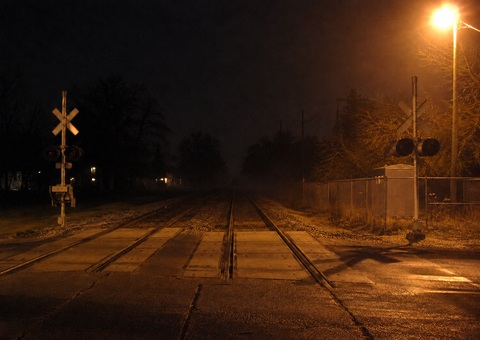
I was at the scene the following morning, June 8. I spoke with three Grayslake Fire Department personnel still on site. One of them, I'll call him Officer D., told me that several passengers had independently mentioned feeling a wave of cold air pass through the car roughly ninety seconds before the derailment. This detail does not appear in the NTSB preliminary report. I filed a public comment with the NTSB in August 2003 citing the historical incident pattern on this corridor. I have not received a response.
Nine deaths. Fourteen incidents. All within 1.1 miles. Zero incidents on the adjacent sections in the same period.
Foote's compass was reading that ground in 1879. The railroad was built in 1880. The first incident was the same year. If you map his anomalous bearing section against the survey grid and then look at where each of these fourteen incidents occurred, you will find yourself looking at the same 580 feet of track. I have that map. I will share it with anyone who asks.
Calendar Notes
I've been asked a number of times about the date pattern, usually by people who think I've cherry-picked the incidents to fit. I haven't -- every incident in this list comes from the public record and I've included them all, including the ones that don't fit. Here's the full picture:
| Incident Date | Notes |
|---|---|
| Oct 31, 1880 | Samhain |
| Feb 2, 1887 | Imbolc |
| Sept 14, 1893 | No Celtic correlation |
| Aug 1, 1901 | Lughnasadh |
| Oct 30, 1908 | Eve of Samhain (one day off) |
| Nov 1, 1921 | Day after Samhain (one day off) |
| Aug 1, 1932 | Lughnasadh |
| Oct 31, 1944 | Samhain |
| Feb 2, 1953 | Imbolc |
| Jan 1965 | Exact day not confirmed in available records |
| May 1, 1966 | Beltane |
| Aug 1, 1979 | Lughnasadh |
| Aug 13, 1979 | Centennial of Connell removal -- not a Celtic date |
| Jun 7, 2003 | No Celtic correlation |
Ten of fourteen incidents fall on or near a Celtic seasonal date. Four don't. The 1893 incident (September 14) and the 2003 derailment (June 7) have no calendar connection I can find. The 2003 incident in particular bothers me -- it's the most serious modern event and it falls in June. I've looked for an explanation and I don't have one. Either the pattern is real and imperfect, or I'm finding what I'm looking for in ten incidents and ignoring that four others don't cooperate. I'm trying to be honest about that.