The History They Don't Teach in Grayslake Schools
Written by Dale R. Hutchins, Grayslake. Updated October 2008.
The Mystery of William M. Gray (1840-1845)
Before Bridget Connell, there was William M. Gray. He's the reason this town has the name it does, and almost nobody asks why he left.
Gray was a Massachusetts native who settled along the unnamed glacial lake in Avon Township in 1840. He farmed the land for five years. The lake was named after him. Eventually the town was named after the lake. And in 1845, with no recorded explanation, he moved to Waukegan. The Encyclopedia of Chicago documents this as fact and says nothing more about it.
I spent the better part of two months in 2000 trying to find out why. Letters to the Waukegan City Clerk, the Lake County Recorder of Deeds, the Newberry Library in Chicago. I found Gray's original land purchase in the Avon Township records. I found documentation of his presence through 1844. And then nothing. He's just gone from the Lake County record in 1845, showing up next in Waukegan. No sold land. No foreclosure. No death in the family. No documented reason of any kind.
The Potawatomi had been removed from Lake County by the Treaty of Chicago in 1833, seven years before Gray arrived. But accounts from the period confirm that at least some individuals remained in the wetlands of Avon Township well into the 1840s. Gray farmed land that had been Potawatomi territory for generations. What he may have encountered in those five years, I can only speculate. Whatever it was, it made him leave.
"There is an atmosphere about certain ground that accumulates from what has happened upon it. It is not superstition to acknowledge this. It is geology of a kind not yet charted." -- Capt. Elias Foote, Wisconsin Central Railroad Land Agent, field journal Vol. II, October 1878 -- written while surveying the Avon Township right-of-way, eight months before the Connell removal.
(Foote Journal, found in crawlspace, Barron Blvd., September 1998. Original in researcher's possession.)
That quote always gets me. Foote wrote it in October 1878. Eight months before he'd ever hear the name Connell. He was a surveyor, a practical man, writing in a field journal that was never meant to be read by anyone but himself. And he still put that down on paper.
Bridget Connell: Origins (1824-1857)
Bridget Moira Connell (nee Forde) was born in 1824 in Ballyconneely, County Galway, on the western coast of Ireland. Her family were coastal farmers and survived the worst years of the Famine, though they lost the land. She and her husband Patrick emigrated to New York in 1853 and made their way to Chicago by 1855.
Patrick found work in Chicago's construction boom. He died in January 1857, struck by a falling beam on a commercial building project on State Street. He was 34. Cook County has a death record.
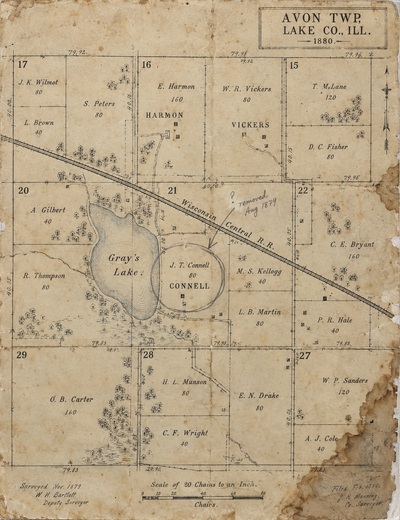
Bridget spent 1857 doing laundry and domestic service. By the spring of 1858 she had saved enough to purchase 18 acres in Avon Township, Lake County. Cheap land, some of it wetland-adjacent, bought from a speculator who had picked it up from its previous owner. No record survives of who that previous owner was, or why they left the parcel. She built a one-room cabin and started farming.
Bridget had the basic herbal knowledge most rural Irish women of her generation carried over. She expanded on it in Lake County through contact with a Potawatomi elder, a woman the settlers called Makewa, who had remained in the wetlands north of Grays Lake after the 1833 removal. Their relationship is documented, indirectly, in a 1869 letter in the Avon Township assessor's records: a neighbor named Silas Harmon writes that he sought a remedy from Connell and was told she needed to first "consult with the old woman in the marsh." The letter is about a property tax dispute, not about Connell at all. The mention is incidental. That's why I believe it.
By the late 1860s she was known to the community. People came to her when the doctor was unavailable or when the doctor had already failed. The testimony of Harriet Vickers Alderman (September 14, 1879, Lake County Township Records) about a fever cure in 1873 is one of several similar accounts I've collected from oral histories and written records of the period.
The Wisconsin Central Arrives (1878-1879)
The Wisconsin Central Railroad was chartered in June 1871 and built southward from Fond du Lac toward Chicago. By 1878, survey crews under Capt. Elias Foote were through Avon Township. The most efficient grade ran directly across Connell's parcel. Twenty years of her life. Her gardens, her cabin, and a plain limestone grave marker for her husband in the east corner of the property, as Foote noted in his survey records.
Wisconsin Central land agents made three separate purchase offers between the fall of 1877 and the summer of 1878. Each was higher than the last. All three were refused. Foote's journal records her stated reason, relayed by the land agent: "She will not take money for the land. She says the ground is not hers to sell."
Think about that distinction. Not "I won't sell." She said the ground wasn't hers to sell. I've been turning that over for ten years.
The railroad went to Lake County. Lake County went to the state. Illinois exercised eminent domain. The compensation offered to Connell was $44.00, which was below the assessed value of the land at the time. She declined to accept it. That $44.00 remained in a Lake County Recorder's suspense account for decades, noted in annual audits as uncollected, until it was written off sometime in the 1930s. I've confirmed this with the Lake County Recorder of Deeds office.
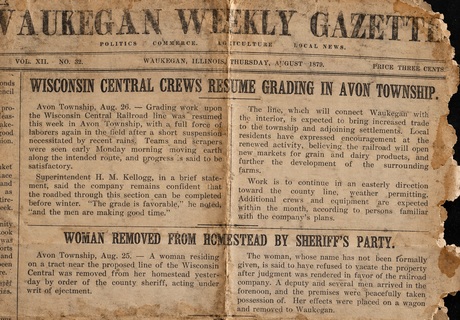
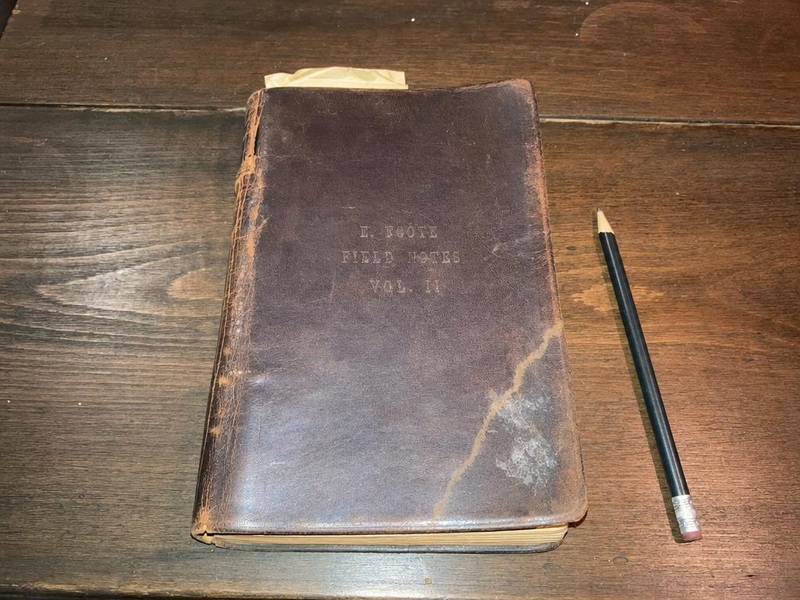
On August 13, 1879, the Lake County Sheriff arrived with a writ and four Wisconsin Central company men. Foote was not at the homestead that morning. He was surveying the right-of-way further north. His entry for that day is compiled from Deputy Sheriff Cobb's account, written up by Foote in camp that evening.
According to Cobb, Connell stood in the doorway and spoke in Irish for approximately two minutes. He could not follow any of it. What he did note was that she appeared to be addressing the ground, not the men. Then she stopped. She went without resistance. She said nothing to the men directly and did not look back at the cabin.
Two of the four Wisconsin Central laborers gave notice that afternoon. No reason offered, none recorded. Foote's note on the matter is one line: "Two of the clearing crew have given notice. They would not say why and I did not press them."
Foote was back on the parcel himself four days later. His entry for August 17 is three pages of field calculations. The last sentence: "The crew will not work past four in the afternoon. They say the air changes. I have told them this is foolishness. I am not entirely certain I believe myself."
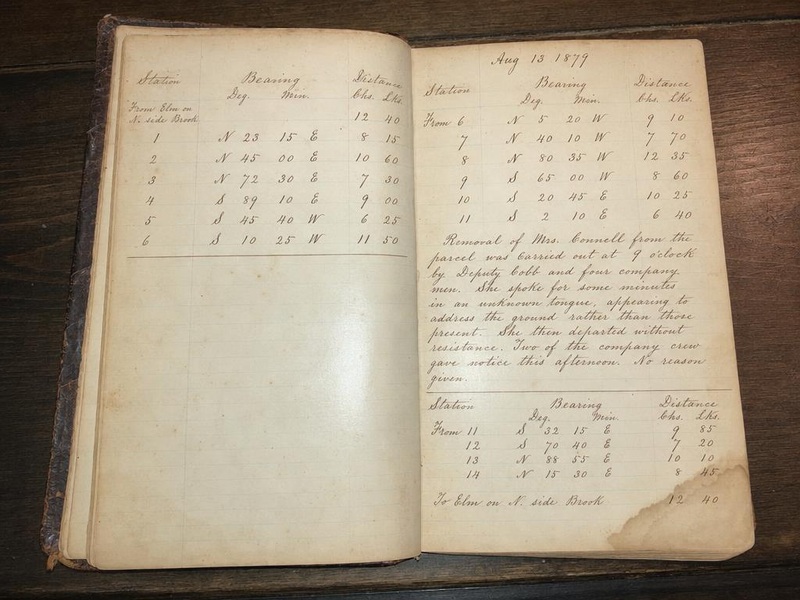
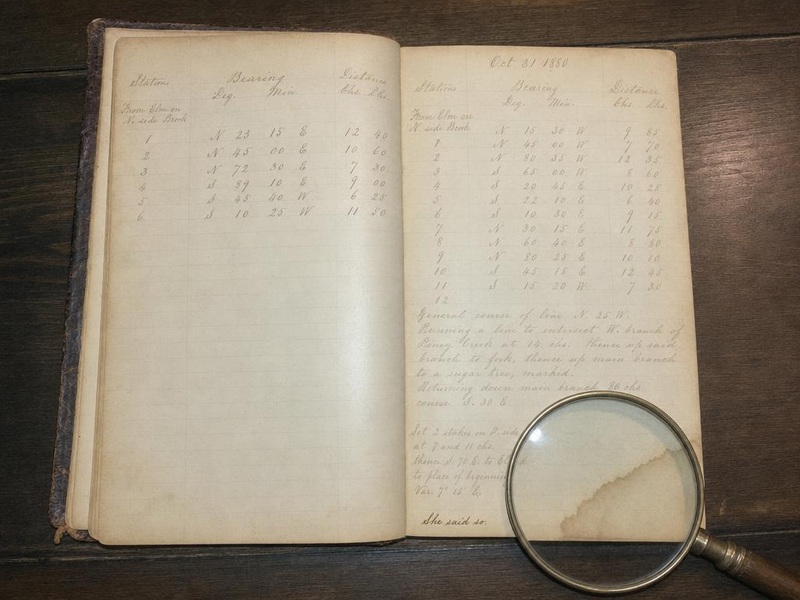
August 13, 1879. Foote's entry for the removal, compiled from Deputy Cobb's account. Note the two laborers giving notice mentioned at the bottom of the column.
|
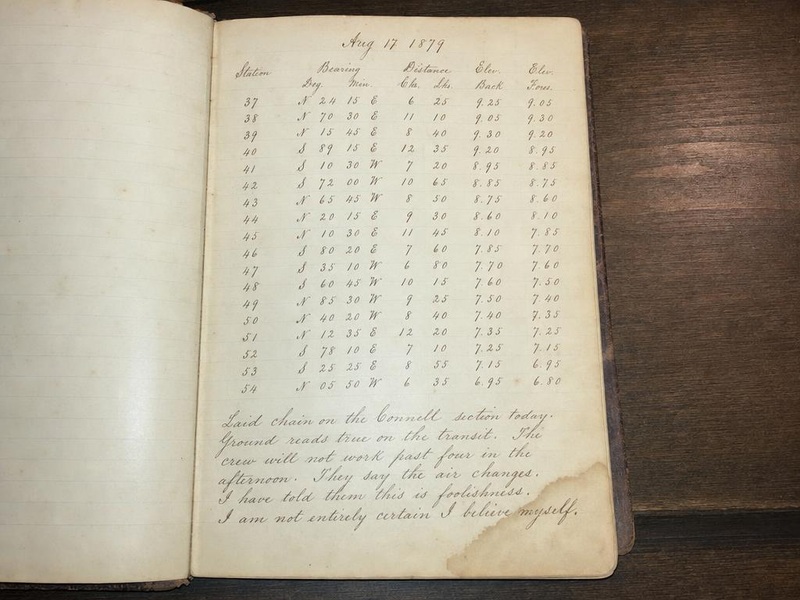
August 17, 1879. Three pages of bearing data. The last sentence is visible at the bottom of this page. He pressed harder on the pen writing it than on the surrounding text.
|
He never writes about the parcel again in any of the three surviving volumes.
What the Survey Notes Actually Contain
For the first four years I had the journal, I was reading the narrative entries, the ones with recognizable words in them. Field journals from this period are mostly columns of numbers: bearings, distances, elevations, gradients. I worked through them because I had to, but I wasn't a trained surveyor and most of it was opaque to me until I could cross-reference it with a historical land survey manual I found at the Newberry Library.
In 2002, when I brought the journal to the Chicago History Museum for a primary-source review with an archivist there, I was photographing the technical pages while she examined the acquisition-history entries. At some point I found myself looking at Foote's bearing readings for the Connell parcel section -- the staked right-of-way between his established control points north and south of the property -- and I noticed something.
Foote was meticulous. Through most of the journal, his compass readings are consistent and orderly, what you'd expect from a professional surveyor. But on the staked right-of-way through the Connell parcel, there's a section where his readings go wrong. He flagged it as "instrument anomaly, to be re-observed." He re-observed two days later. Same result. He applied a correction and moved on.
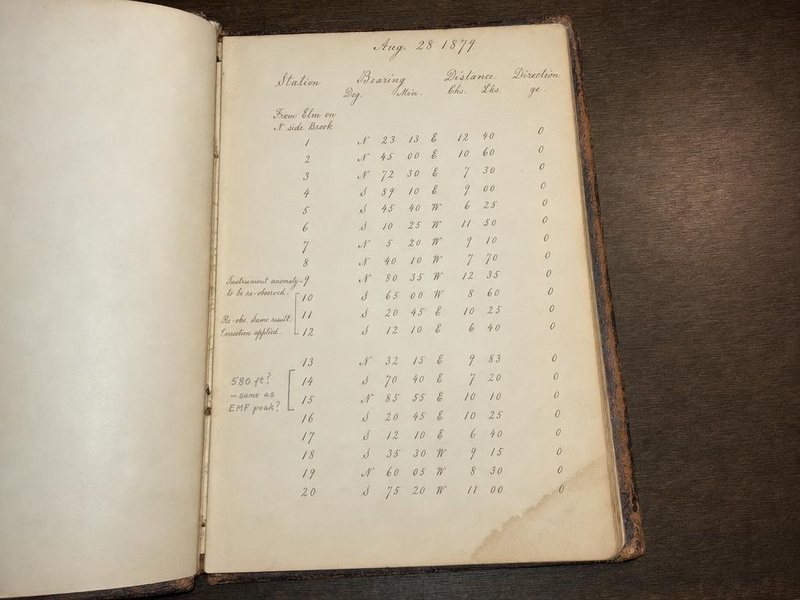
He never re-observed it a third time. He never explained it. He used the corrected figures in his final survey record, the one the railroad used to lay track, and moved on.
When I went back to those pages in 2002 and tried to map the anomalous section against Foote's survey grid, it seemed to correspond to the same general stretch of ground where my EMF readings are consistently elevated. I say "seemed" because I'm not a surveyor, and there's enough uncertainty in my translation of 130-year-old field notation that I don't want to overstate the precision of that match.
I wrote to a couple of geologists about it. One didn't respond. The other, a retired USGS geologist, wrote back and said glacial till in the Lake County area can sometimes contain enough ferrous material to produce localized compass anomalies, and that what Foote described wasn't impossible. He said any real conclusion would need subsurface investigation. I wrote back to ask about that. He didn't reply. I don't know if he was just busy or if he'd decided the question wasn't worth his time.
Glacial till would explain the compass deviation. I'm not sure it explains all of it: the location, the EMF readings, the pattern of incidents. It might be coincidence. That's the honest answer.
What I keep coming back to is the timeline. Foote's compass was reading that ground in August 1879. The track was built in spring 1880. Connell had been living on the parcel for 21 years. William M. Gray had lived nearby for five years and left without explanation in 1845, fifteen years before Connell arrived. Whatever is in that ground, glacial till or something else, was there before any of it.
The Disappearance (August 20, 1879)
Bridget Connell was last seen on August 20, 1879, at the Lund farmstead in Avon Township, about a mile and a half north of her former homestead. She asked for water and bread. She told Ingrid Lund, the farmer's wife, that she was going north, "to where the old woman is." She did not carry much.
After that: nothing. No death record. No hospital. No poorhouse. No notation in any county ledger or census that I have been able to find. Lake County records for this period are reasonably intact and I've spent a lot of time with the microfilm. She is simply not in them.
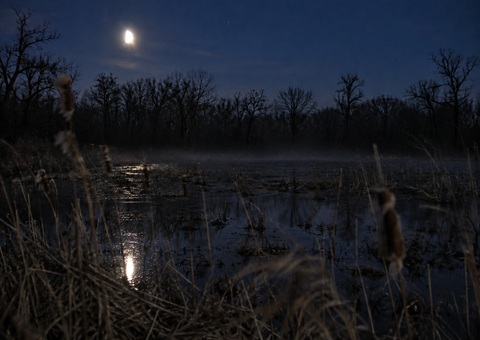
The tamarack marsh north of Grays Lake, where Makewa was reported to have lived, covered several hundred acres in 1879. Most of it was drained by the early twentieth century as agriculture expanded and wetlands were reclaimed. What survives is now part of Rollins Savanna Forest Preserve, a 1,200-acre Lake County Forest Preserve in north Grayslake. The marsh edge nearest the old rail corridor is accessible by trail.
I've been there at night, with instruments. What I've found is on the Evidence page.
Full Timeline
What This Means
I've thought for a long time about how to characterize what I believe happened here, and I've settled on being straightforward about it: I think Bridget Connell spoke something on that doorstep in August 1879 that attached itself to the ground she was standing on. She had spent two decades cultivating a relationship with that land, with its soil, its water, its history going back through Makewa's knowledge and further back than that. Whatever she said in Irish that morning, whatever she was doing when she directed it at the ground, it has been working ever since.
William M. Gray felt something on adjacent ground and left after five years without explaining why. Bridget Connell spent twenty-one years on it and then had it taken from her. Those are different experiences of the same place.
And then this: the town that grew up on and around that land was named after the man who left. Not after anyone who stayed. Not after anyone who built it or was buried in it. After the man who walked away. As if the naming were a kind of apology.
The first step toward addressing whatever is happening on that corridor is admitting that something is happening. That has not occurred yet, to my knowledge, in any official capacity.
-- Dale R. Hutchins, Grayslake, October 2008